//

Wedding
Complete Guide: Planning a Wedding in Israel in 2026
From the Huppah to the seating chart, discover everything you need to know to plan a successful wedding in Israel in 2026: traditions, budget, vendors, timeline, and practical tips for local couples and those from the diaspora.
1The Israeli Wedding: A Celebration Like No Other
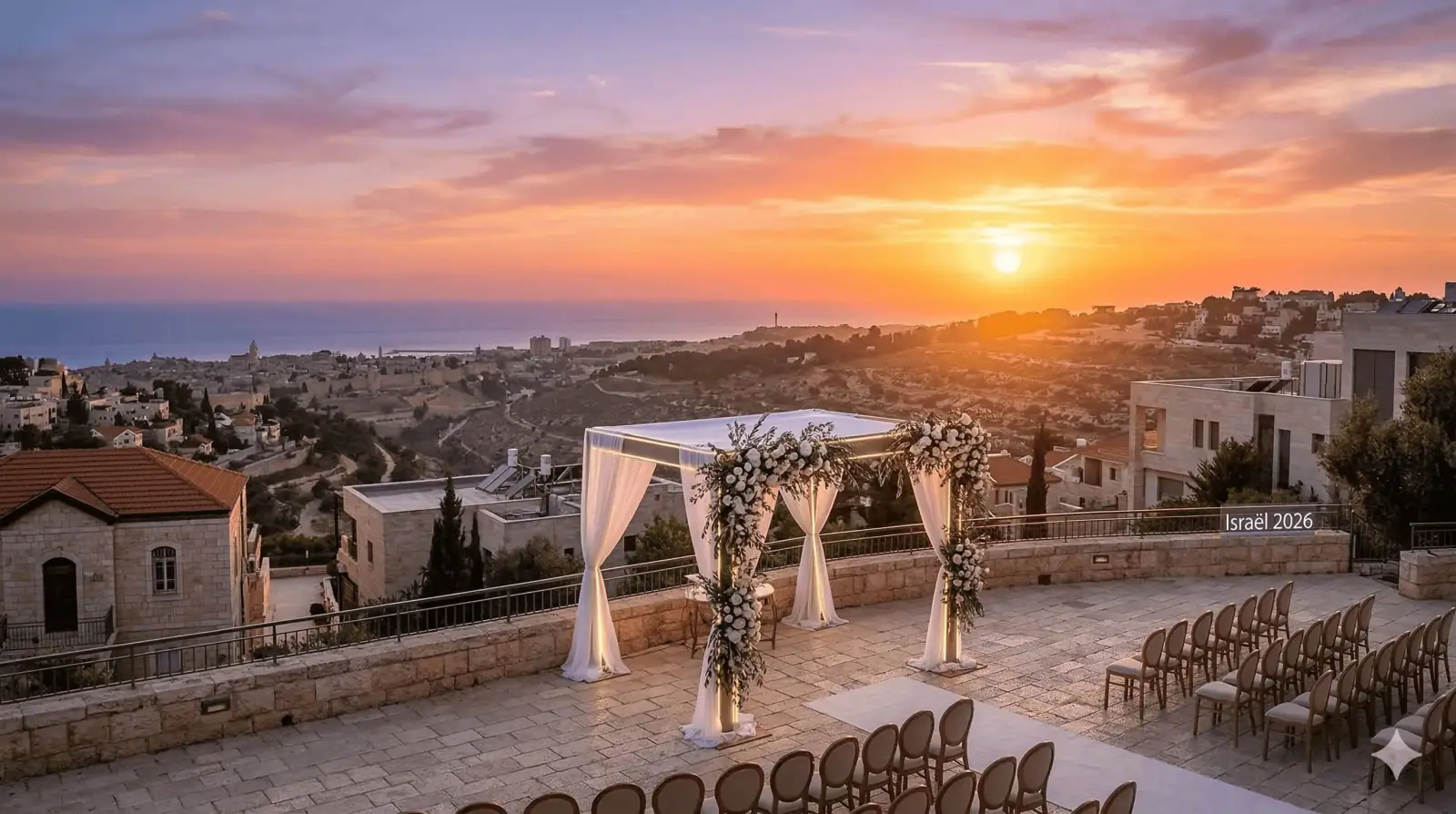
Getting married in Israel is an experience like no other. Far more than a simple ceremony, it is a true collective celebration where every guest becomes part of the festivities. Unlike European or American weddings, often planned down to the finest detail, the Israeli wedding stands out for its boundless energy, millennia-old traditions, and a contagious spontaneity that leaves a lasting impression.
300+
guests on average
50 000+
weddings per year in Israel
150-600K
ILS average budget
What immediately strikes you when attending an Israeli wedding is the scale of the event. With an average of 250 to 350 guests — and frequently over 500 in extended families — weddings in Israel are large-scale events. This tradition of generosity is partly explained by the custom of cash gifts: each guest brings an envelope containing a sum of money to help the couple cover the reception costs. The more guests there are, the more the couple can offset the evening's expenses.
Beyond these two poles, Israel offers an exceptional diversity of settings: the vineyards of the Galilee, the beaches of Carmel, the spectacular deserts of the Negev, or the lush gardens of the coastal plain. Each region brings its own palette of colors and atmospheres to your celebration.
For diaspora couples who choose to get married in Israel, the experience takes on an additional dimension: that of returning to one's roots. Getting married in the land of your ancestors, under a starry Mediterranean sky, surrounded by family from around the world, means anchoring your union in a millennia-old history while writing a new chapter.
MazalDay Tip
Whether you are planning an intimate wedding of 100 people or a grand celebration of 500 guests, start by defining your vision and your budget. MazalDay's budget planning tool allows you to simulate different scenarios based on the number of guests and your chosen region.
It is also important to note the cultural richness of Israeli weddings. Sephardi and Ashkenazi traditions coexist and blend, creating unique celebrations. Couples of Sephardi origin often incorporate a Henna ceremony (hina) a few days before the wedding, with traditional clothing, Middle Eastern pastries, and Mizrahi music. This cultural diversity is one of the great treasures of weddings in Israel, where each celebration tells a unique family story, blending Moroccan, Yemenite, Iraqi, Russian, French, or Ethiopian origins.
2Planning Timeline: 12 Months to Organize Everything
Planning a wedding in Israel requires thorough preparation, ideally over 12 months. The best vendors are booked early, especially for popular dates (May-June, September-October). Here is a detailed timeline, step by step, so you don't miss a thing.
12
months before
Laying the Foundations
- Set the overall budget with both families (who pays for what?)
- Determine the approximate number of guests
- Choose the season and 2-3 possible dates
- Begin the process with the Rabbinate (if having a religious wedding)
- Visit the first reception venues (Ulam)
10
months before
Book the Essentials
- Sign the contract with the venue (Ulam) — this is the most important decision
- Book the photographer and videographer
- Hire a DJ or a band (Lehaka)
- Contact a rabbi for the Huppah (חופה) ceremony
8
months before
Aesthetics and Style
- Choose the wedding dress (Simla) and the groom's suit
- Select the florist and define the decoration concept
- Order the artistic Ketubah (כתובה)
- Book the makeup artist and hairstylist
6
months before
The Important Details
- Finalize the guest list and send Save the Dates
- Taste menus with the caterer (if not included with the venue)
- Book transportation (shuttles for guests if needed)
- Organize the Henna ceremony (for Sephardi families)
- Plan the honeymoon
3
months before
Sending Invitations and Coordination
- Send invitations (Hazmanot, הזמנות) — paper or digital
- Confirm all vendors and schedules
- Final dress fitting and alterations
- Plan the preliminary seating chart
- Choose the wedding rings
1
months before
The Final Sprint
- Finalize the seating chart with RSVP confirmations
- Detailed briefing with each vendor
- Organize the bachelor/bachelorette party
- Prepare tip envelopes for vendors
- Last fitting and dress pickup
J
The Day
The Big Day
- Morning photo session (optional, very popular in Israel)
- Bride's makeup and hair
- Final check of the venue and decorations
- Delegate coordination to a close friend or the wedding planner
- Enjoy every moment!
Did You Know?
MazalDay's built-in task checklist automatically generates a personalized timeline based on your wedding date. Each task is linked to a vendor category, allowing you to find the right professionals directly in our directory.
3Jewish Wedding Traditions in Israel
The Jewish wedding in Israel is rich with ancestral traditions that date back thousands of years. Each ritual carries deep significance and helps make this celebration a sacred moment. Here are the essential traditions every couple should know.
MazalDay Tip
For diaspora couples unfamiliar with these traditions, we recommend meeting with your officiating rabbi at least 3 months before the wedding. They will guide you through each ritual and help you personalize the ceremony. On MazalDay, browse our "Rabbis & Officiants" category to find the rabbi who matches your religious sensibility.
4When to Get Married in Israel? Seasons and Dates to Avoid in 2026
Choosing the date is one of the most strategic decisions for a wedding in Israel. Between climate constraints, the Hebrew calendar, and high-demand periods, careful planning is essential. Here is a complete guide to seasons and dates to avoid in 2026.
Dates to Absolutely Avoid in 2026
Important Note
Don't forget that Jewish weddings cannot be held on Shabbat (from Friday evening to Saturday evening). In Israel, the most popular days for weddings are Tuesday (considered doubly blessed according to the Torah) and Wednesday. Sunday is also common and often cheaper. Thursday is generally the most expensive day, as it offers the entire weekend for celebrations.
For diaspora couples, it is crucial to also consider French or American school holidays to facilitate guest attendance. The All Saints', Christmas, or February vacation periods are particularly suitable for a destination wedding in Israel, where the climate remains mild even in winter.
MazalDay Tip
Use MazalDay's checklist to set up automatic reminders linked to key dates in the Hebrew calendar. Our tool automatically verifies that your chosen date does not fall on a religiously restricted period.
5Legal Procedures: Rabbinate, Civil Alternatives, and Cyprus Weddings
The legal framework for marriage in Israel is unique in the world and can surprise unprepared couples. Unlike most Western countries, Israel does not have civil marriage on its territory. Understanding the different available options is essential to properly prepare your union.
~800
ILS Rabbinate fees
3-6
months of procedures
18+
years minimum age
The process with the Rabbinate can take several weeks or even months, especially for recent immigrants (Olim Hadashim) or diaspora couples whose Jewish status needs to be verified. It is strongly recommended to begin the process at least 6 months before the planned date. The Rabbinate also requires the couple to attend marriage preparation sessions (Hadracha, הדרכה) covering the laws of family purity (Taharat HaMishpacha).
Important for Diaspora Couples
If you are a couple from abroad wishing to get married in Israel, plan to have all your official documents (birth certificate, single status certificate, divorce decree if applicable) translated and apostilled by a sworn translator recognized by the Israeli authorities. The process can take 2 to 3 months from abroad. Start as soon as your date is set.
6The Typical Flow of an Israeli Wedding
An Israeli wedding follows a well-established flow, blending religious traditions and exuberant festivities. Whether you are a guest or a future bride or groom, here is what to expect, hour by hour, during a typical wedding evening in Israel.
18h
arrival
Kabbalat Panim (קבלת פנים) — Welcoming the Guests
Guests arrive and are welcomed with a generous cocktail: sushi stations, cocktail bars, antipasti, and often a dessert corner. In Israel, the Kabbalat Panim is a true mini-event in itself, lasting 45 minutes to 1 hour. Music is already playing, the atmosphere is warm. Guests greet the couple (separately in traditional weddings).
18h30
ritual
Tish and Hakhnasat Kallah (הכנסת כלה)
During the Kabbalat Panim, two parallel ceremonies take place. On the men's side, the Tish: the groom is surrounded by his friends who sing, drink, and sign the Ketubah. On the women's side, the Hakhnasat Kallah: the bride, seated on a chair of honor, receives congratulations and blessings from her female guests. In modern weddings, these two spaces may be merged.
19h
veiling
Bedeken (בדקן) — The Veiling
The most emotional moment of the pre-ceremony. The groom, carried in triumph by his friends singing and dancing, walks toward the bride to cover her face with the veil. This intense moment lasts 5 to 7 minutes and is often accompanied by tears of emotion from both sides. The rabbi pronounces blessings over the bride.
19h15
ceremony
Ceremony Under the Huppah (חופה)
The heart of the wedding. Procession to the Huppah: brothers, sisters, and grandparents first, then the groom accompanied by his parents, and finally the bride. Under the Huppah: blessing over wine, the bride's seven circuits (Hakafot), giving of the ring with the declaration "Harei at mekudeshet li" (הרי את מקודשת לי), reading of the Ketubah, Sheva Brachot, and finally the breaking of the glass followed by the famous "Mazal Tov!". Duration: 20 to 30 minutes.
19h45
private
Yichud (יחוד) — The Private Moment
The couple retreats to a private room for an intimate moment symbolizing their new status as husband and wife. It is traditionally the moment to break the fast and share a first meal in private. Duration: 10 to 15 minutes.
20h
party!
Dancing, Dinner, and Celebrations
This is where the Israeli wedding reaches its full glory. Unlike Western weddings, in Israel, people often start dancing BEFORE dinner. The Rikudei Am (folk dances) set the dance floor on fire. The couple is lifted on chairs during the Hora. Then comes the seated dinner, followed by more dance sessions. No rigid seating chart in traditional weddings — but more and more modern couples are adopting one. No tiered wedding cake to cut in Israeli tradition, but the dessert stations are spectacular.
23h+
end
Last Dances and End of the Evening
Israeli weddings often end after midnight, with increasingly intimate dance sessions. The last guests form a circle around the couple for soft songs. The Birkat Hamazon (grace after meals) and the final Sheva Brachot officially conclude the evening.
MazalDay Tip
Even though Israeli tradition doesn't call for a formal seating chart, more and more couples are opting for organized seating to ensure their guests' comfort. MazalDay's seating chart tool allows you to create your layout with drag-and-drop, with different table shapes (round, rectangular, oval), and export the result as a PDF for your vendors.
7Budget and Costs: How Much Does a Wedding in Israel Cost in 2026?
The budget is often the most stressful topic for couples-to-be. In Israel, costs vary considerably depending on the region, season, number of guests, and level of service. Here is a detailed guide to help you plan your wedding budget in 2026.
150K
ILS average budget
40-60%
venue and catering share
250-350
ILS/guest on average
The cost of the venue and catering represents by far the largest budget item. In Israel, the majority of reception halls (Ulamot, אולמות) operate with a per-guest price that includes food, basic beverages, and the venue. This price varies enormously depending on location:
Beware of Hidden Costs
Don't forget to add VAT (Ma'am, 17%) to the quoted per-guest price. Also ask whether the premium bar, valet service, outdoor air conditioning, and overtime hours are included. ACUM music licensing fees (~300 ILS) are mandatory. Also budget 20-35 ILS per guest for bar service and 180-250 ILS per additional server.
An Israeli specificity not to be overlooked: cash gifts from guests allow you to recover a significant portion of the costs. In 2026, the average envelope amount is around 300-500 ILS per person (more from close family). With 300 guests, this can represent 90,000 to 150,000 ILS. But be careful: don't count on these gifts to balance your budget, as the actual amount remains unpredictable.
MazalDay Tip
MazalDay's budget management tool allows you to create a detailed budget by category, track your expenses in real time, manage deposits and payment deadlines, and visualize your cost breakdown through interactive charts. Start by entering your total budget and number of guests — the tool automatically suggests a balanced allocation.
8Choosing Your Vendors: The Keys to a Successful Wedding
Your choice of vendors will largely determine the success of your wedding. In Israel, the market is vast and competitive, which is both an opportunity and a challenge. Here is a category-by-category guide to help you make the right choices.
MazalDay Tip
Find all your wedding vendors in one place on MazalDay. Our directory brings together over 15 categories of vendors in Israel, with detailed profiles, photo galleries, verified reviews, and the ability to directly contact each professional. Use our filters by region, budget, and event type to find the ideal vendor.
With MazalDay's integrated guest list, manage your RSVP confirmations, organize by households and groups, and import your contacts from a CSV file. Everything is synchronized with your seating chart and budget for stress-free planning.
In conclusion, planning a wedding in Israel in 2026 is an ambitious project that requires preparation, organization, and a good dose of foresight. But the result is worth every effort: an unforgettable celebration, rooted in millennia-old traditions, bathed in Mediterranean sunshine, and carried by the unique energy of Israeli weddings. Whether you are a local or diaspora couple, Israel offers an exceptional setting to begin your life together. Mazal Tov!
Ready to Find Your Vendors?
Explore our directory of quality event professionals
You Might Also Like
Discover more articles to inspire your planning

The Complete Guide to Choosing Catering for Your Event in Israel
In Israel, food is the beating heart of every celebration. Discover all the keys to navigating flavors, kosher certifications, and local logistics.
12 min read

The Ultimate Wedding Checklist: 12 Months of Stress-Free Planning
Everything you need to know to plan your dream wedding, month by month. Tips, timelines, and expert secrets for a flawless celebration.
12 min read